The Verification Gap
Why agentic commerce needs an evidence layer
GoBuy Position Paper · September 2026
Executive summary
In eight days in September 2026, agentic commerce closed its transactional questions. Shopify shipped Checkout WebMCP — tools for AI agents to read, update, and complete purchases inside a customer's browser session. The UCP protocol formalized consent. Web Bot Auth gave agents cryptographic identity. OpenAI announced always-on agents; Meta's Muse became the first mass-market personal shopping agent and was connected to Shopify checkout within days. An AI agent can now prove who it is, obtain permission, and execute a purchase, end to end, without human intervention.
Amazon answered by building walls — blocking Meta's agent to protect an advertising business grossing $19.81 billion in a single quarter, with Google and OpenAI reportedly weighing their own restrictions. Commerce split three ways: walls, doors, and dots.
And every path, on every side of the split, still ends at the same place: an unverified star rating.
This paper names that problem — the Verification Gap: the distance between what an agent can transact and what it can trust — and argues three things. First, the gap is structural, not incidental: the same platforms that solved transactions cannot close it without conflict. Second, closing it requires a new kind of layer — independent, forensic, agent-native, explainable — not better plugins on existing rails. Third, the pattern that wins is one line long: verify, then checkout. Identity, consent, execution, evidence — in that order. The first three shipped this month. The fourth is the next phase of agentic commerce.
1. The eight days that closed the transaction
The compression is worth pausing on, because it explains why the gap surfaced now.
Shopify Checkout WebMCP. Shopify exposed its checkout to AI agents as first-class MCP tools: get_checkout, update_checkout, complete_checkout. An agent operating in a user's browser session can now assemble a cart, apply changes, and complete payment under the user's established session and consent — not by scraping screens, but through the merchant's own checkout surface. Paired with Web Bot Auth (agent identity via Ed25519 key pairs that storefronts can verify), the "who is allowed to act" question gained a real answer.
The consent layer. The UCP protocol's census counted more than 17,000 stores with verified agentic-commerce capability — consent, as a machine-readable property of the storefront, stopped being speculative.
Always-on agents. OpenAI's dots announced persistent agents that shop, book, and act across sessions. The unit of commerce shifted from "a session where a human clicks" to "an agent with standing authorization."
The consumer door. Meta's Muse reached #1 on the US App Store days after launch and was connected to Shopify for e-commerce and Stripe Link and PayPal for payments. The first mass-market personal shopping agent arrived with checkout wired in.
The walls. Amazon blocked Meta's Muse crawler, explicitly protecting its advertising business — $19.81 billion in the most recent quarter as reported — with Google and OpenAI reportedly planning their own agent restrictions. The incumbent marketplace chose ad revenue over agent access, which is a rational decision that also announces the terms of the next decade: whoever controls the listings decides what agents may see.
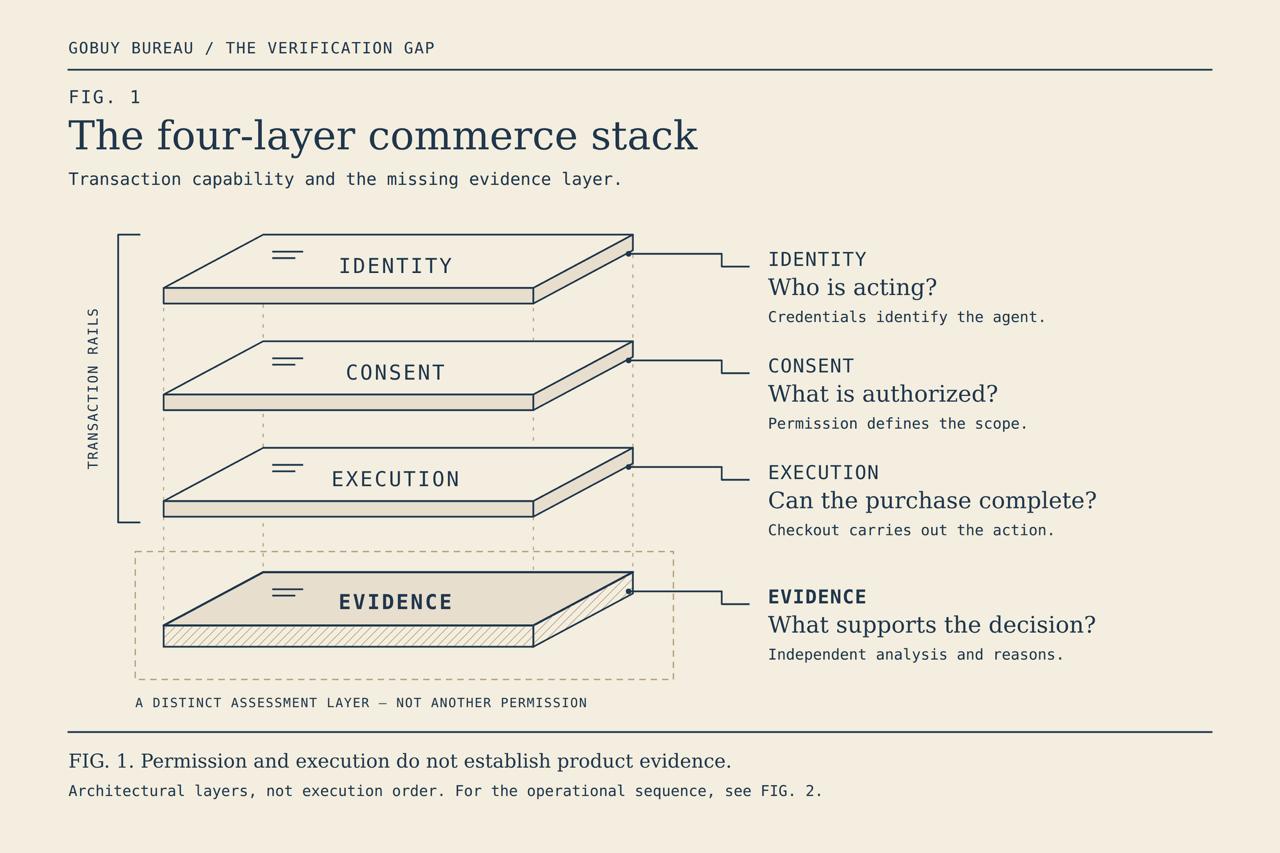
The transactional stack — identity, consent, execution — is, suddenly and provably, done. What none of these announcements shipped is a way for the agent to know whether what it is buying is worth buying.
2. The gap: what the agent trusts
Consider what a competent shopping agent does today. It receives intent ("restock my running shoes"). It searches, ranks, and shortlists — reading dozens of listings where a human would seriously consider two or three (Acosta's research puts consumer consideration at 2–3 options against roughly 25 available). It executes checkout through the new rails in milliseconds.
Every one of those steps is now excellent except the middle one. The ranking rests on marketplace-provided aggregates — a 4.4-star average, a review count, a bestseller tag — whose integrity nobody in the chain verifies:
- Scale. Amazon itself reported blocking more than 275 million suspected fake reviews in a single year, before largely declining to continue reporting the figure. The U.S. Federal Trade Commission banned fake reviews outright, with civil penalties — a rule that exists because the practice is industrial.
- AI generation. Recent measurement (Pangram Labs, September 2026) found roughly 3% of reviews on Amazon bestsellers are AI-generated — and 93% of them carry the Verified Purchase badge. The badge that platforms offer as integrity evidence no longer discriminates.
- Economics. Planting reviews is cheap and profitable; the expected penalty is rare. When a product's ranking rises on fabricated evidence, every honest competitor pays a tax and every buyer pays the difference.
A human shopper once diluted this problem with slowness: they browsed two or three options, noticed oddities, and asked a friend. The agent inherits none of that friction and none of that skepticism. It shortlists twenty-five, reads everything, verifies nothing, and executes. The machine is a perfect amplifier for fabricated evidence — faster, more confident, and trusted by its principal.
This is the Verification Gap. It is not a bug in any single platform. It is the missing layer of a stack that was completed, from the outside, in a week.
3. Why the incumbents cannot close it
The reflex answer is that the platforms will fix it themselves. They will not, and the reasons are structural.
| Actor | Incentive | Conflict |
|---|---|---|
| Marketplaces | conversion, ad revenue, GMV | the evidence layer and the ad business share a P&L — fake reviews inflate engagement metrics, and verification would reprice ad inventory against reality |
| Agents | task completion, user retention | the agent's principal wants purchases to succeed; doubt is friction, and the agent is a fiduciary of no one |
| Merchants | sales | interested parties by definition; self-attested trust is what we are trying to replace |
| Model providers | deployment and safety optics | reluctant auditors of third-party commerce; they have no data relationship with the listings their agents buy |
Amazon's blockade makes the pattern vivid: a marketplace that monetizes the listing cannot simultaneously be the independent measure of the listing. The analogy is old and exact — S&P is not a bank; UL does not sell appliances; the Michelin company's tires are not rated by Michelin Guides' advertisers. Independent evidence requires independence: no marketplace equity, no affiliate upside, no ad revenue whose value moves with the scores.
4. What closes it: design criteria
A credible evidence layer for agentic commerce has four properties. None is optional, and any missing one collapses the others.
1. Independence. No equity, affiliate, or advertising relationship whose value moves with a score. The layer's only product is the truthfulness of its scores; its revenue must come from time (monitoring, SLAs) and display (certification), never from the score itself.
2. Review forensics, not aggregates. Star averages restate the problem. Forensics analyze individual reviews: verified-purchase distributions; temporal burst detection (paid campaigns cluster five-star arrivals in tight windows); near-duplicate text analysis (bought reviews are template variants); rating-shape analysis (authentic distributions carry real one-stars; manipulated ones don't); and adjusted ratings — the star average recomputed with suspicious reviews down-weighted. The output is not "4.4 stars" but "4.1 adjusted; 18% of sampled reviews flagged, with reasons."
3. Agent-native delivery. The layer must live where the decision happens: MCP tools an agent calls before checkout, in milliseconds, keyless. A website a human visits after the purchase is a museum, not a rail.
4. Explainability. Every score decomposes into signals a journalist, regulator, developer, or rival can audit. Black-box trust is another unverified star rating with extra steps.
5. The pattern: verify, then checkout
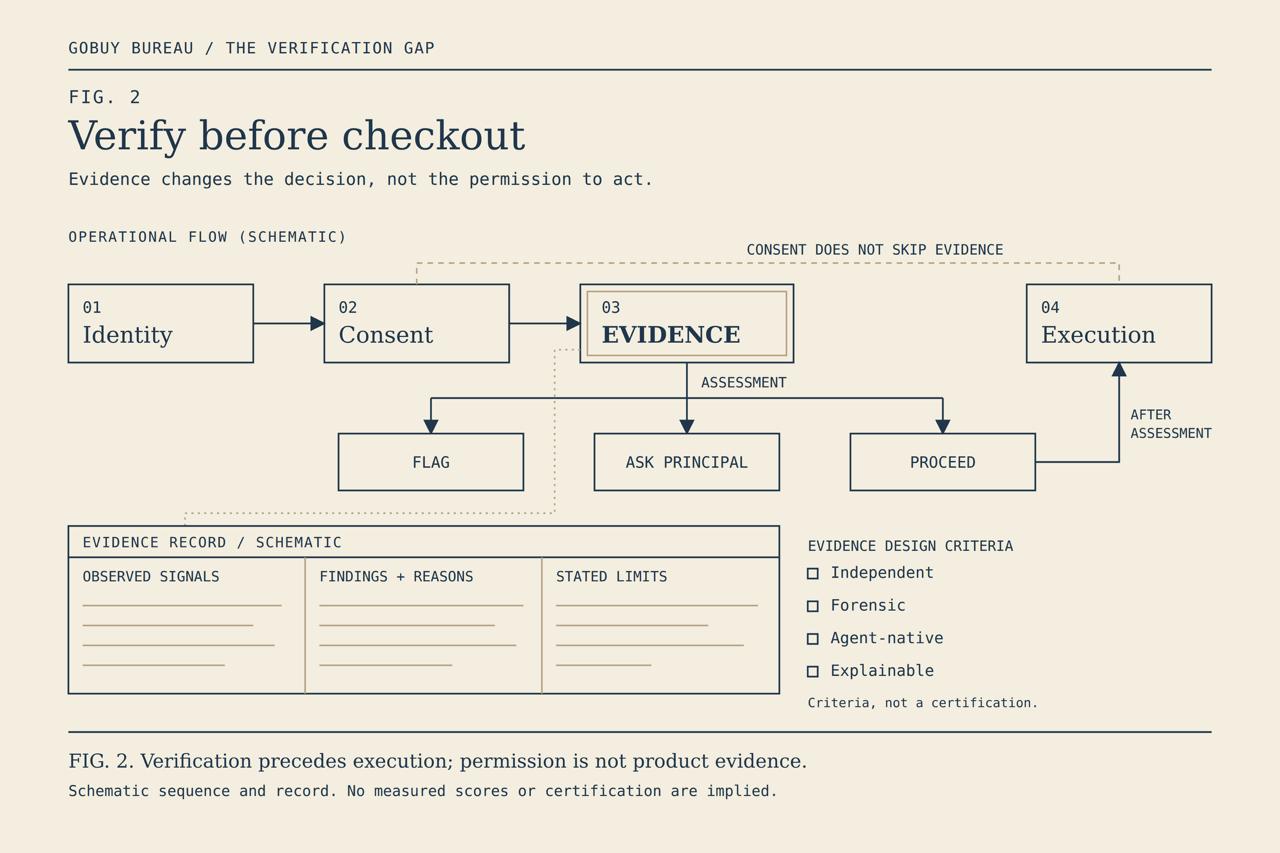
The integration is one line long, which is the point.
identity (Web Bot Auth) → consent (UCP)
  → EVIDENCE (independent scores) → execution (complete_checkout)
Concretely, for an agent building on Checkout WebMCP:
check_store_score({domain}) — is this storefront trustworthy? Score, tier, agent-readiness; unscored stores can be scanned live.
check_product_trust({retailer, product_id}) — does the product's evidence hold? Where review integrity has been analyzed, it surfaces.
analyze_reviews({...}) — optional deep forensics: adjusted rating, suspicious-percentage, signal breakdown.
Proceed, flag, or ask the human — then complete_checkout.
Decision guidance is deliberately simple: strong store tiers proceed; weak or unknown tiers flag; unanalyzed evidence is stated as such, never implied. The agent that follows this pattern can tell its principal why it chose the product it bought — which, as agents multiply, stops being a feature and becomes the purchase criterion.
6. One implementation exists
The criteria above are not hypothetical. GoBuy implements them today:
- Product evidence — 30,000+ scored listings across Amazon, Walmart, and Target, with review-authenticity weighting; on-demand review forensics over ~100 individual reviews per analysis (integrity score, adjusted rating, flagged-review counts, full signal breakdown).
- Store evidence — an independent Top 100 index of Shopify and independent storefronts (stores.gobuy.ai), each scored for agent-readiness and trust, with live on-demand scanning of unknown stores.
- Agent-native delivery — a keyless MCP server (mcp.gobuy.ai/mcp) with five tools, rate-limited, documented, listed in the agent ecosystems' directories; the integration pattern above is published at docs.gobuy.ai/webmcp.
- Independence — no marketplace equity, no affiliate links, no ad revenue. The scores are the product, and the methodology is public.
GoBuy is presented here not as the only possible implementation but as proof the layer is buildable now, with current rails, at current prices — pennies per verification.
7. Predictions
Verification becomes a phase. The 2025 conversation was "will agents transact"; the 2026 conversation, post-WebMCP, is "will agents be trusted." The 2027 conversation is evidence.
The evidence layer consolidates. Networks of trust collapse toward a citation standard — one layer whose scores agents check, platforms embed, and journalists quote. First mover with independence intact holds the slot.
Agent identity arrives next. Web Bot Auth gave agents keys; eventually something will rate the agents — who do you trust to buy for you. The same criteria apply, one object later.
The walls raise the price of independence. Every blockade makes the independent layer more valuable to everyone outside the wall — including, eventually, the walled gardens' own merchants.
Conclusion
September 2026 solved the transaction. The question agents cannot answer is everything around it: are these reviews real, is this store honest, is this product what it claims. That question will be answered by a layer that is independent, forensic, agent-native, and explainable — or it will not be answered at all, and agentic commerce will scale the noise it inherited.
Verification is the remaining work of agentic commerce. The criteria are known, the pattern is published, and the first independent implementation is already in production. What remains is adoption — by agents, by platforms, and by the humans who trust them.
Sources referenced as reported: 24/7 Wall St. (Amazon ad revenue); Amazon brand-protection disclosures (fake review enforcement); FTC final rule on fake reviews (2024); Pangram Labs (AI-generated review measurement, Sept 2026); Acosta shopper research (consideration sets); Computer Weekly and TechCrunch (Muse commerce integrations); Shopify developer documentation (Checkout WebMCP, Web Bot Auth).
GoBuy — the trust layer for agentic commerce. Position paper, September 2026. docs.gobuy.ai · mcp.gobuy.ai/mcp · stores.gobuy.ai
GoBuy — the trust layer for agentic commerce · Homepage · docs.gobuy.ai